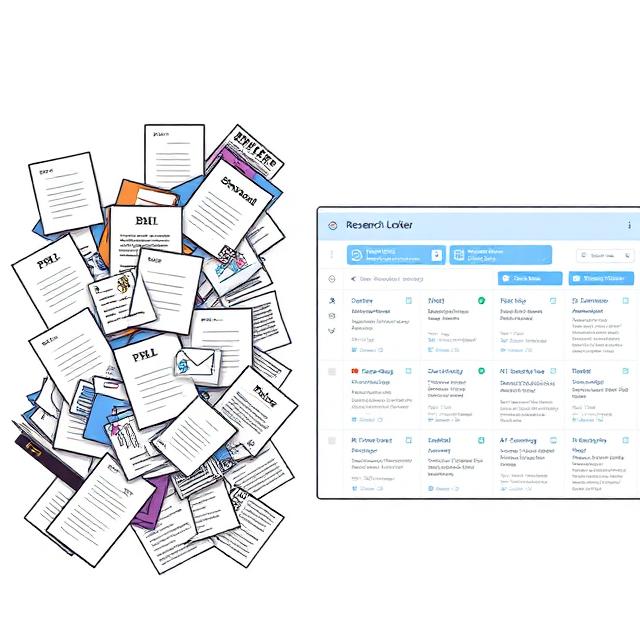
Every researcher knows the moment.
You download a journal article after purchasing it from a publisher like Springer, BMJ, Elsevier, or Wiley. You read it, save the PDF somewhere, and move on to the next task.
Months later, you suddenly need that same article again.
And then the search begins.
You check your email receipts.
You search through your downloads folder.
You open multiple directories hoping the file name looks familiar.
Sometimes you find it.
Sometimes you don’t.
In many cases, researchers end up spending more time searching for articles than actually reading them.
This problem is more common than most people realize.
The Growing Challenge of Managing Research Articles
Modern researchers interact with an enormous amount of academic literature. Between journal subscriptions, purchased articles, preprints, and downloaded PDFs, managing information becomes increasingly difficult.
Typical issues researchers face include:
- Losing track of purchased journal articles
- Storing PDFs across multiple folders and devices
- Difficulty remembering article titles or file names
- Managing references across different projects
- Spending unnecessary time searching for previously downloaded papers
These challenges become even more noticeable for professionals working in:
- Pharmaceutical research
- Medical writing
- Regulatory affairs
- Academic research
- Policy analysis
- Consulting
In these fields, efficient research management is not just helpful — it is essential.
Why Traditional Folder Systems Fail
Most researchers rely on basic folder structures like:
Research Papers
   ├── BMJ Articles
   ├── Springer Papers
   ├── Systematic Review
   └── Downloads
While this may work initially, it becomes difficult to maintain over time.
File names are inconsistent.
Metadata is missing.
And searching for articles months later becomes frustrating.
Without a structured system, research libraries quickly turn into digital clutter.
The Importance of Metadata and DOI Information
One of the most powerful tools in academic publishing is the Digital Object Identifier (DOI).
A DOI contains rich metadata about a paper, including:
- Article title
- Authors
- Journal name
- Publication date
- Abstract
- Publisher information
When properly captured, this metadata makes research far easier to organize and search.
Unfortunately, when researchers manually download PDFs, that metadata often gets lost.
This is where better research management tools can make a significant difference.
Building a Personal Research Library
An effective research management workflow should allow researchers to:
- Store purchased PDFs in a centralized location
- Automatically capture article metadata
- Organize papers by topics or projects
- Search articles quickly by author, keyword, or journal
- Access research materials from any device
Instead of relying on scattered folders, researchers benefit from having a structured digital research library.
Such a system helps researchers focus on analysis, writing, and discovery — rather than file management.
A New Approach to Managing Purchased Research
To address these challenges, tools are emerging that focus specifically on organizing purchased research articles.
One such tool is Research Locker, which helps researchers create a clean, searchable library of their journal articles.
With Research Locker, users can:
- Paste a DOI to automatically fetch article details
- Upload and organize research PDFs
- Search articles by author, journal, publisher, or keyword
- Create collections for different research projects
- Access their research library from anywhere
The goal is simple: make it easier to store, find, and revisit research.
Why Organization Matters in Research
When researchers can easily locate their articles, several benefits emerge:
- Faster literature reviews
- More efficient writing workflows
- Reduced duplication of article purchases
- Better knowledge retention
- Improved collaboration across teams
Research should be about discovery and insight — not about hunting through folders.
Final Thoughts
Academic research continues to grow at an incredible pace. Every year, millions of new papers are published across thousands of journals.
As the volume of information increases, the need for better research organization becomes even more important.
Researchers who develop strong systems for managing their articles will save time, reduce frustration, and improve productivity in the long run.
If you’re looking for a better way to organize your purchased research papers, you can explore Research Locker here:
👉 https://researchlocker.co/library
Building a structured research library today can save countless hours in the future.
Leave a Reply