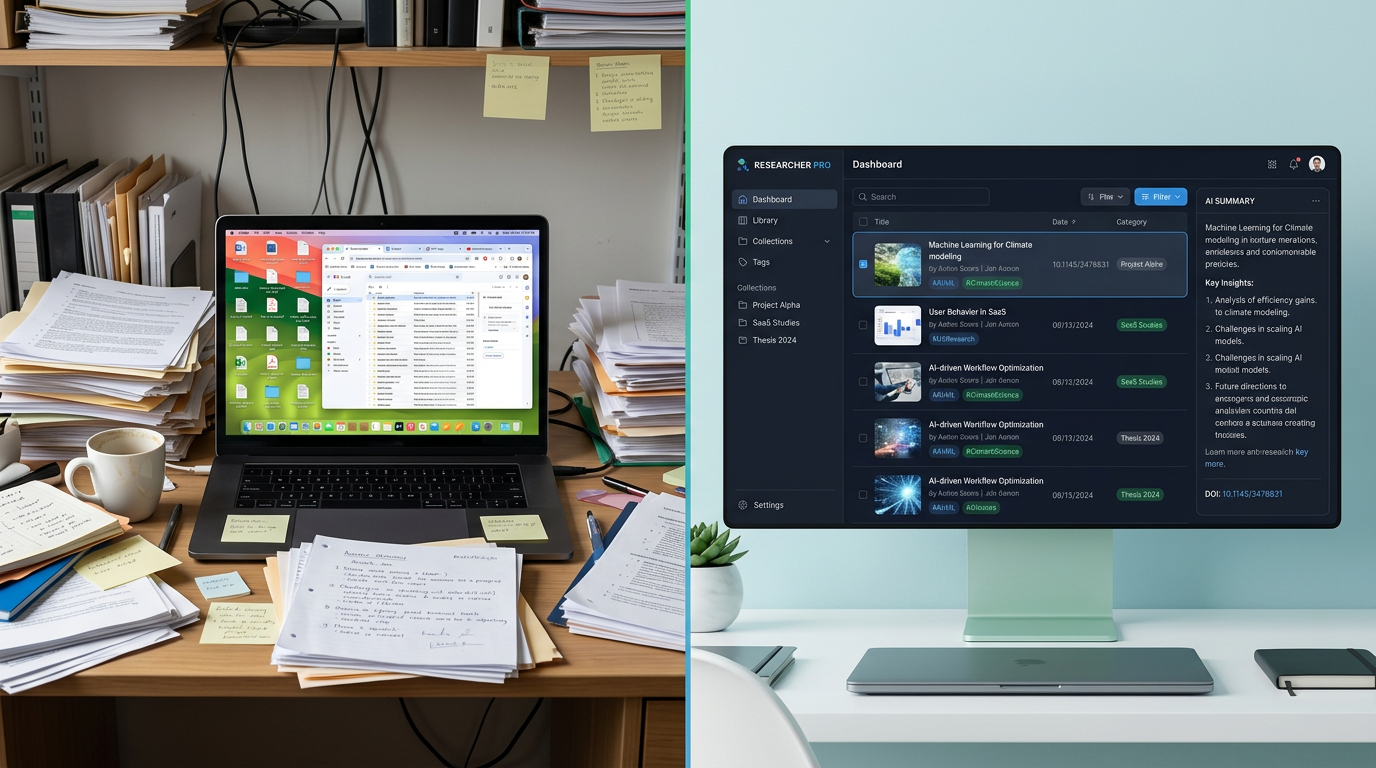
For decades, the biggest challenge in research was access.
Today, that problem is largely solved.
Researchers can purchase articles instantly from journals like Springer, BMJ, Elsevier, and Wiley. With a few clicks, high-quality research is available on demand.
But a new problem has quietly taken its place:
Researchers can access information easily — but struggle to manage it effectively.
And this problem is costing time, money, and productivity every day.
The Hidden Chaos Behind Every Research Workflow
Let’s be honest about what happens after downloading a research paper.
You:
- Save the PDF to your downloads folder
- Maybe rename it (or maybe not)
- Move it into a folder (sometimes)
- Read it once
- Forget where you saved it
Weeks or months later, you need that same paper again.
Now you:
- Search your desktop
- Check email receipts
- Open multiple folders
- Try different keywords
- Eventually give up… or re-download it
This isn’t rare.
It’s how most researchers work.
Why This Problem Is Bigger Than It Looks
At first glance, this seems like a small inconvenience.
But over time, it creates serious issues:
⏳ Time Loss
Researchers spend hours searching for papers they already have.
💸 Duplicate Purchases
The same article gets purchased more than once.
🧠 Cognitive Load
Managing files becomes mental overhead.
📂 Fragmented Knowledge
Important research is scattered across systems.
🔁 Inefficient Workflows
Literature reviews become slower and more frustrating.
This isn’t just about organization —
it’s about how efficiently research can happen.
Why Traditional Tools Don’t Fully Solve It
You might think existing tools are enough.
But each has limitations:
Folders & Drives
Good for storage, bad for retrieval.
Reference Managers
Built for citations, not for managing purchased PDFs.
Not designed for long-term research organization.
Notes Apps
Helpful, but disconnected from actual files and metadata.
None of these tools are designed specifically for:
Managing purchased research articles over time.
What an Ideal Research System Should Do
A modern research workflow needs more than storage.
It should:
- Instantly capture article details
- Keep PDFs and metadata connected
- Allow fast searching across multiple fields
- Organize research by topic or project
- Reduce manual effort
- Help researchers revisit knowledge easily
In short, it should act like a personal research library, not just a storage system.
A Simpler, Smarter Approach
This is where tools like Research Locker come in.
Instead of treating research as files, it treats it as structured knowledge.
With Research Locker, you can:
🔹 Add Articles Using DOI
Paste a DOI and instantly get:
- Title
- Authors
- Journal
- Abstract
- Publisher details
No manual entry needed.
🔹 Use AI to Understand Papers Faster
AI-generated summaries help you:
- Quickly grasp key insights
- Review papers efficiently
- Save time during literature reviews
🔹 Search Everything Instantly
Find articles using:
- Author name
- Keywords
- Journal
- DOI
- Publisher
No more digging through folders.
🔹 Organize with Tags & Collections
Group research by:
- Topics
- Projects
- Methods
- Areas of interest
Build a structured research system that grows with your work.
🔹 Access Journal Sources Anytime
Quickly return to original journal pages when needed.
🔹 Keep All PDFs in One Place
No more scattered files.
Everything lives in one clean, accessible library.
The Real Shift: From Storage to Structure
The biggest change is not technical — it’s conceptual.
Instead of thinking:
“Where did I save this file?”
You start thinking:
“My research is already organized.”
That shift saves time, reduces stress, and improves productivity.
A Question Worth Asking
If someone asked you right now:
“Can you find a paper you bought 6 months ago in under 10 seconds?”
Would you confidently say yes?
If not, your research system needs improvement.
Final Thoughts
Access to research is no longer the challenge.
Managing it effectively is.
As the volume of academic content continues to grow, researchers who invest in better organization systems will gain a significant advantage.
Because in the end, research is not just about collecting information —
it’s about being able to use it when it matters most.
Try It Yourself
If you’re curious to see how a structured research library works:
👉 https://researchlocker.co/library
Paste a DOI and experience it directly.
Leave a Reply